Who Decides? Architecting Human-AI Partnership
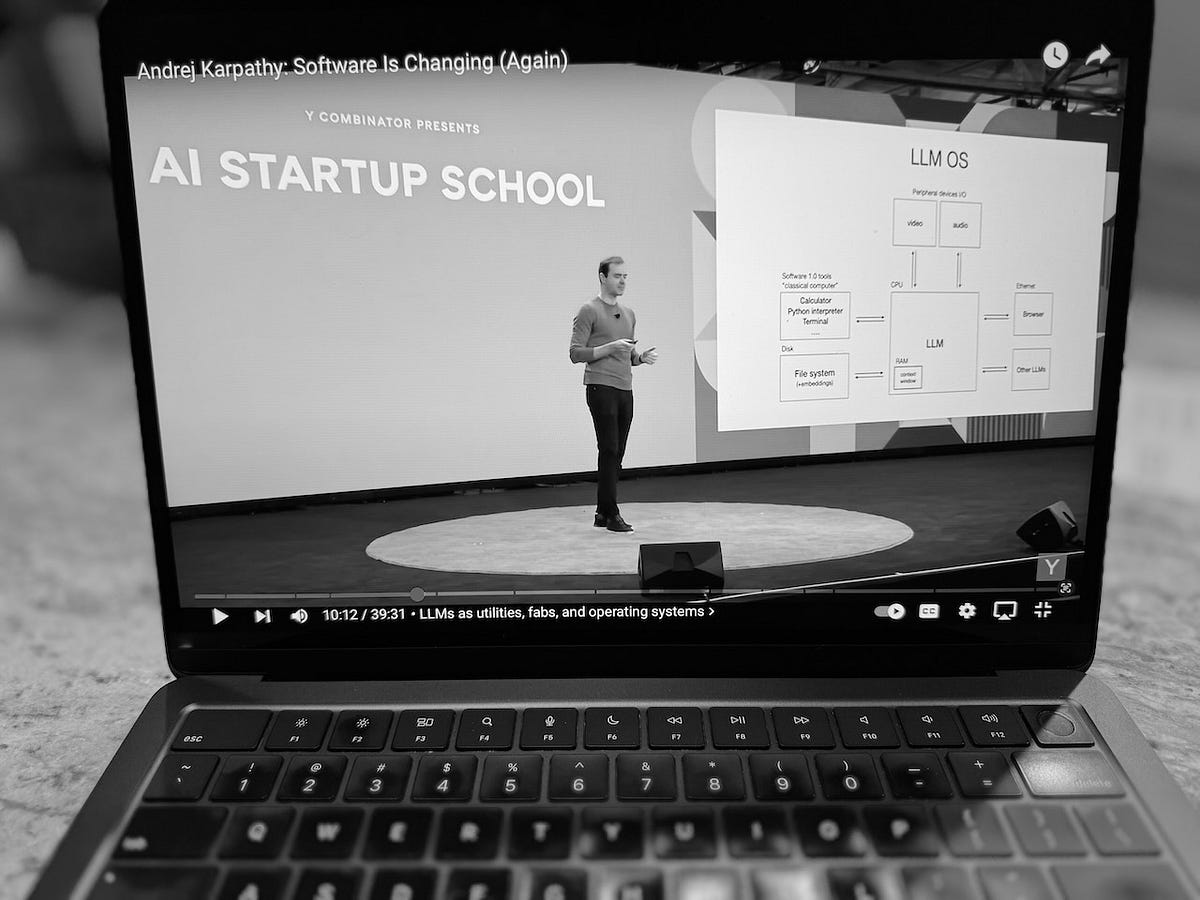
My dad is the definition of technologist, with his understanding of computers and technology starting with feeding machine-level code with punch cards back in the 70s. He rode the wave of new programming languages as they started to take hold and usher in a completely new era of software. So when my dad sends me links to read and videos to watch, I pay attention, because it’s usually about the deeper nature of computing. Last week he sent me a YouTube link to Andrey Karpathy’s talk, a talk generally summed up as an overview of the next new paradigm in technology and computing, coining it “Software 3.0”. In the talk, Karpathy talks about LLMs as a new operating system, programmed in natural language instead of code. He goes further explaining that this paradigm shift brings with it a new psychology for all of us, trying to put shape to the idea that LLMs are not people, but “people spirits”, able to simulate human-like psychology, but distinctly are not (a position I wrote about recently as well).
In all, Karpathy’s talk is an excellent review of how AI and LLMs in particular are so transformative that they will change how we currently interact and work with technology, moving to this new operating system. For a Gen-X person that spent most of his life squarely in the Software 1.0 paradigm (technology is made to do work through specialized code and software), I’m stepping back again to look at how I need to change (my frame of mind for technology, how I solve problems today, how I plan for the future) and figure out what it means to work within this new technology operating system.
We’re Not There Yet (But We Can See it From Here)
Karpathy’s operating system metaphor is powerful and I think appropriate. But I know there is still a huge gap between recognizing this new OS and actually using it inside real organizations. Most AI implementations I see are pretty straightforward replacements for existing work. Email drafts, requirements documentation, marketing briefs, all plugging into how we work today. Same workflows, same work. A new operating system requires thinking differently about how we work today, and with AI, it steps back from our typical day in the office and challenges every aspect, even just putting hands on keyboards. And this is where most of us get stuck. There is this incredible new way to do work sitting in front of us, but we’re trying to manage it the same way we do our work today.
I needed to step back from my keyboard and think a little more deeply about how we do work in the future with AI in the picture.
What the Research Tells Us About Partnering with AI
So, I went diving in arxiv.org to see who is thinking about this new partnership, and I found a recent paper from Zou and colleagues that pushes the conversation beyond the simplistic “human-in-the-loop” model. They argue that the rush toward full AI autonomy is premature and that progress should be measured by how well AI can work with humans, not by how independent it becomes.
They call for a focus on “LLM-based Human-Agent Systems (LLM-HAS)”, which is a really long way of saying the AI functions as an active teammate rather than an independent operator. This goes beyond a human checking the AI’s work. This partnership is more dynamic: humans provide guidance and assume control when needed, but the system is also designed for deeper collaboration.
Evidence supports this thinking. A study from Ethan Mollick and a team at Harvard Business School of 776 professionals at P&G found that individuals using AI performed on par with two-person teams that did not have AI. Beyond that, they cited AI acting as a “boundary-spanning mechanism”. Without the AI, professionals stayed inside their functional silos; but when using AI, they produced more balanced, holistic solutions on their own, effectively replicating the knowledge-sharing function of a human teammate.
I love this research because while the industry chases autonomy, I think we should be designing these collaborative systems. Using a framework like my Partnership Matrix, which maps how to engage (Automation, Augmentation, etc.). But my previous article stops short of defining how to do this, how to identify the specific roles are needed to make this collaborative workflow..work?
Finding DARE (and Why It Clicked)
Last year, I was dealing with a mess at work. Our product, engineering, and business teams kept colliding over who could make decisions and the tried and true RACI wasn’t working because it just doesn’t address ownership clearly. While looking for alternatives, I stumbled across the DARE framework from McKinsey. It stands for: Decider, Advisors, Recommenders, Execution Stakeholders. The genius of DARE is its simplicity married to a single person who is the accountable decision maker.
During Karpathy’s talk it occurred to me that DARE, though designed for human teams, makes a lot of sense for human-AI partnerships. It provides a missing operational layer for the Partnership Matrix. The AI naturally fits in the Recommender and even Advisor role across the Augmentation and Exploration zones of the Partnership Matrix.
For example, consider a bug-triage workflow. An AI bot can act as the Recommender, analyzing a new ticket, suggesting its priority level, and identifying potentially related code. A senior staff engineer can serve as an Advisor, validating the AI’s technical assessment. But the Engineering Manager is always the Decider, making the final call on assigning the ticket and committing team resources.
Businesses and people alike need accountability to be clear so that we can trust the system enough to use it, and that almost always means a human is ultimately at the end of that chain.
Architecting the Patterns of Partnership
So how do these frameworks apply to the AI tools and apps we use today? I was having a conversation with Ala Stolpnik at Wisary.ai last month about this and she helped me see two dominant patterns where this architecture is taking shape, whether intentionally or not.
- AI for Individual Productivity. Think of a product manager drafting a PRD with ChatGPT . This fits squarely in the Augmentation and Exploration zones of the Partnership Matrix. In DARE terms, the AI is a Recommender, generating ideas and text. The human is the Decider, questioning, verifying, and owning the final output.
- AI as a Product. This is where AI is embedded directly into team workflows, like a design tool suggesting code changes or, for example, building your PRD collaboratively through Jira with Wisary.ai. This is the _Automation_zone of the Matrix, but with guardrails. Here, the AI acts as both Recommender, Advisor, and Execution Stakeholder, but only within preset boundaries. The human Decider always retains veto power.
Both patterns highlight Karpathy’s generation-verification loop, but they also carry a risk if we aren’t careful. Faster decisions aren’t necessarily better decisions. The goal of this architecture is to create a system that elevates human judgment, which is the ultimate source of value.
What This Actually Means
If you’re lucky enough to know someone who’s been around computing all their life (thank you Dad) they provide a long view of history that shows how this point in time is much more than just the introduction of a new programming paradigm.
Asserting that a human is the accountable “Decider” is the critical first step, but it’s not enough. In a world anxious about AI safety (where watchdog groups grade major labs “C or below”) we have to operationalize that accountability. This means building tangible guardrails around our AI teammates: defining what we mean by accuracy, maintaining audit logs to review decisions, and implementing evaluation (eval) suites to constantly check performance.
All hyperbole aside, we really are in the middle of a foundational change to how we live and work. And we need to keep talking, writing, and experimenting to flesh out what that looks like, and how we keep humans at the center of it.
We don’t need AI to do everything. We need to know who decides what, and why.
More from AI-Human Partnership

Embrace the Mess
Working with AI is messy on both sides — probabilistic outputs, answers that have to be argued with, judgment calls neither side could make alone. The disproportionate outcomes come from staying in the back-and-forth instead of trying to engineer the mess away.

Beyond the Loop
Human in the loop is a good place to start, but working with AI as a genuine partner — where roles stay fluid and context compounds over time — unlocks work you can't build alone.

Making It Personal
AI doesn't have to be something that happens to you. Personal use is where you build the relationship, the judgment, and the agency to shape how AI shows up in your work and life.