The End of Traditional Product Management?
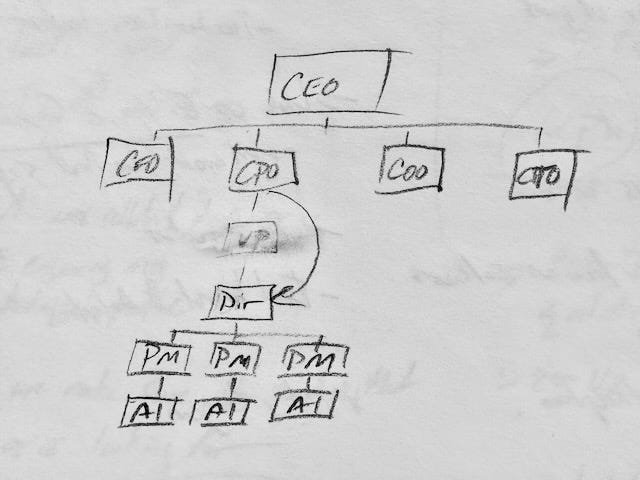
In my last article, losing my job pushed me to question my entire career path: was I chasing a role that wouldn’t even exist in five years? What began as a personal crisis quickly became a larger realization about our industry. Traditional product management roles, once clearly defined and stable, are undergoing profound, permanent shifts driven by AI and changing organizational structures.
Companies hiring product managers today prioritize technical depth and AI fluency over traditional product experience. Strategic thinking still matters, but I’m seeing a growing expectation that product managers should both craft strategy and drive hands-on execution. The separation between thinkers and doers is shrinking, and not just at small companies and startups.
Traditional product management, heavy on meetings, documentation, and oversight, is starting to feel increasingly outdated. AI is speeding up the transition toward smaller, technical, decentralized product teams, permanently reshaping what effective leadership means.
What is Actually Breaking Down?
1. The Problem of “Product Management Theater”
Marty Cagan talks a lot about “Product Management Theater”, where product managers spend their days in endless meetings rather than building products. Every product manager has experienced this. In my own career, I’ve spent countless hours attending meetings that seemed critical but rarely drove real progress. Roadmap reviews shifted constantly, alignment meetings rarely created lasting alignment, and “crucial” PRDs collected dust while actual delivery slowed.
Over the past decade, especially during the pandemic hiring boom, companies added layers of product managers onto increasingly complex products and sprawling portfolios. But when layoffs hit, those same product managers were disproportionately impacted compared to engineers and technical contributors. Companies chose to keep technical expertise, cutting roles centered around coordination and administration.
2. AI is Automating Coordination Tasks
AI tools now easily handle administrative tasks mid-level PMs traditionally managed. Amplitude autonomously analyzes user behavior and suggests product improvements. ChatGPT and ElevenLabs handle documentation and summarize meetings, tasks that previously consumed enormous amounts of time.
At WHOOP, AI augmented “discovery trios” (a PM, a designer, and an engineer) have dramatically improved efficiency by reducing meetings and manual coordination. According to Hilary Gridley, WHOOP’s Director of Product Management, her team has significantly increased productivity. This aligns closely with Marty Cagan’s vision: lean, empowered teams focused on discovery and delivery, freed from bureaucratic overhead because AI handles coordination.
As a leader, I’m focused less on how individuals adapt and more on a larger, unanswered question. What should product teams look like once AI takes over substantial parts of today’s product management work? That’s the question I need answered before I can confidently map out my next career step.
What’s Missing from This Conversation
Many still frame current layoffs and AI-driven shifts as temporary, assuming the job market and product roles will stabilize when the economy rebounds.
I strongly disagree. We’re witnessing something deeper: AI is permanently reshaping how product teams operate. At Charter, I saw firsthand how flatter teams made faster decisions with significantly less overhead. Today, senior product roles are noticeably harder to find, with fewer VP-level positions advertised and hiring shifting toward technical, AI-fluent contributors. McKinsey research further confirms that flatter organizations move faster and more efficiently.
Companies have experienced leaner structures with fewer middle managers, and few have reason to return to old habits.
The Two Paths of Modern Product Leadership
This shift is directly reshaping career paths for product managers, splitting into two distinct directions.
On one hand, we see the rise of highly technical “Super ICs” (a term popularized by Claire Vo), product leaders who code alongside engineers, leverage AI to model pricing, and validate designs through synthetic user testing. These individuals use AI to handle routine coordination, freeing them to do deep creative and analytical work.
On the other hand, many product leaders are becoming strategic advisors who focus less on daily execution and more on linking product initiatives directly to business outcomes and customer needs.
Gartner reports that 70% of CIOs plan to adopt product-centric models within the next few years, specifically seeking PMs with deep knowledge in AI/ML fundamentals, probabilistic decision-making, and ethical AI governance.
This career split raises an essential question. In this new world, who actually leads product strategy? When execution is increasingly automated by AI and spread across smaller teams, how do companies ensure their products feel like coherent experiences rather than disconnected features?
How Product Leadership Must Evolve with AI
This question remains largely unanswered. If AI handles coordination and Super ICs manage execution, what role remains for product leadership?
Leadership doesn’t disappear; it evolves. Leadership roles previously built around direct management and detailed oversight must shift toward broader alignment, strategic coherence, and ecosystem-level decision making. Rather than simply owning roadmaps, product leaders now architect the environment in which smart decisions emerge.
This raises critical, unanswered questions:
- How do we ensure coherent experiences with decentralized execution
- Who mediates when AI-driven initiatives conflict?
- What distinguishes exceptional product leaders when they’re no longer directly managing execution?
VP roles built around people management and PowerPoint decks look increasingly outdated.
How Product Leadership Must Evolve with AI
As AI reshapes product teams, leadership must fundamentally evolve.
For years, product leaders were measured by how well they managed execution and maintained predictable workflows. As AI increasingly assists with backlog management, stakeholder alignment, and prioritization, the real opportunity now lies in shaping systems, curating insights, and ensuring AI-driven decisions stay connected to human experiences.
Leaders who thrive in this landscape won’t control every detail; they’ll create conditions for AI augmented teams to move fast without losing strategic coherence. Instead of competing with AI on efficiency, they’ll bring what machines can’t: context, judgment, and the ability to balance speed with long-term vision.
AI’s impact extends far beyond task automation. It is fundamentally reshaping how teams collaborate. The Agile methodologies and ceremonies that defined our industry for decades are beginning to strain under these pressures.
In my next article, I’ll explore what comes after traditional Agile implementations, highlighting how AI-driven teams are redefining collaboration and execution while still honoring Agile principles. I’ll break down how AI is transforming frameworks like Scrum and Kanban, where they still work, where they’re breaking down, and what comes next.
More from AI in Product Leadership
The Interface Roadmap: Beyond the Chat Box
AI interfaces shouldn’t default to chat boxes. Teams that build platform logic and preserve context can embed intelligence where users already work.
Back to the Future: Why AI Needs the Business Logic You Already Have
“Your teams already have the business logic AI needs — it's just implicit. Making tacit decision-making explicit is the real challenge of AI integration.”
Why Every Product Roadmap Needs Meaning
AI-driven velocity without purpose leads teams to ship faster while mattering less. Product leaders need a context roadmap alongside their feature roadmap.