Forget Agile, This Is How AI Will Actually Change Product Teams
Many product leaders connected with my recent article about losing my job and questioning the future of product management. Their messages shared a common thread: uncertainty about how AI will reshape not just individual roles, but our entire approach to building products.
This goes beyond the expected (and inevitable?) automation of some product roles and tasks. Something much more fundamental is happening. AI challenges the core processes we’ve relied on for decades, particularly in how we implement Agile and organize our Product Operations.
Agile Was Never About the Ceremonies
Remember when Agile felt revolutionary? It freed us from waterfall processes and promised faster, more adaptive product development focused on shared understanding between teams. But over time, many organizations turned Agile into exactly what it was supposed to replace: rigid processes with mandatory ceremonies that often add more overhead than value.
I’ve seen this firsthand in my career. Teams devote countless hours to standups, sprint planning, and retrospectives, while struggling to deliver meaningful impact. The very framework designed to make us nimble became bureaucratic.
Now AI enters the picture, promising to automate these ceremonies. But automating inefficient processes doesn’t fix them, it just helps them fail faster. With AI as part of the process, we need to fundamentally rethink how teams work together to build products.
The Reality Check: AI’s Impact on Product Operations
Product Operations exists as a function to help teams work efficiently while staying connected to customers. The introduction of AI tools and GenAI systems dramatically shifts that balance across the entire product development lifecycle. But is it helping?
In Agile Implementation & Execution, AI promises to automate standups, sprint planning, and backlog refinement. But in reality? Teams are more likely to disengage from these ceremonies as Agile becomes something that happens “to” them rather than “with” them.
For Roadmapping & Prioritization, AI can rank features based on historical data and market trends. But this type of approach usually leads to nearsighted focus that often favors short-term optimization over bold strategic bets that could transform a product or market.
In Customer Research & Insights, AI excels at synthesizing user feedback, support tickets, and NPS data. This genuinely speeds up pattern recognition, though it can’t help the team feel the deep human empathy for customers dealing with issues.
For Go-To-Market & Launch Operations, AI helps generate positioning documents and competitive comparisons. But strategic positioning still requires deep market understanding that provides a level of intuition that only human expertise can provide.
When it comes to OKRs & Reporting, AI auto-generates progress reports and identifies at-risk goals. The downside? Just like any output-driven organization, AI-optimized KPIs might encourage teams to chase numbers instead of meaningful impact.
In Cross-Functional Coordination, AI flags dependencies and automates stakeholder updates. Unfortunately, this likely leads to AI-generated status updates replacing meaningful discussions and necessary context, weakening shared alignment between teams and stakeholders.
For DevOps & CI/CD, AI optimizes deployment pipelines and flags security vulnerabilities. While this speeds up releases, it can also shift risk assessment toward automation, making certain edge-case failures harder to catch.
And in DesignOps & UX Workflows, AI generates UI variations and assists with accessibility audits. The problem is that AI-driven design suggestions tend to optimize for trends and common patterns across its training, not brand consistency or human intuition.
My takeaway here is that AI will absolutely transform how product teams, engineering teams, and design teams work together. The jury is still out on whether that leads to a better product or more efficient product operations.
AI & Agile: A Battle-Test of Implementation Changes
AI can profoundly impact execution-heavy processes, especially standard Agile implementations. AI clearly looks to make Agile more mechanized, but we can also see the risks:
- AI removes friction, but also removes valuable team discussions
- Agile loses its core goal: continuous learning and improvement
- Teams become passive executors instead of active problem-solvers
The larger the system, the harder it becomes to change course. In scaled Agile implementations like SAFe, AI has the potential to deepen complexity or unlock real efficiency, depending on how it’s applied. That’s why the focus shouldn’t be just on AI’s effect on Agile, but on how it reshapes Product Ops at a fundamental level.
AI’s Role in Product Ops: Transformation or Feature Factory Trap?
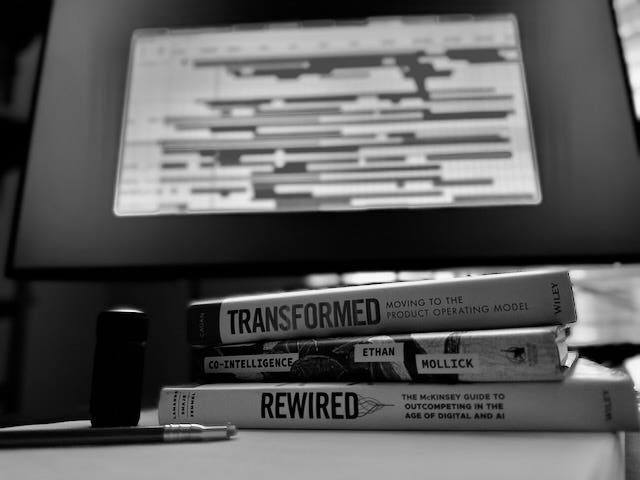
Marty Cagan’s book Transform argues that most product organizations don’t actually operate as empowered product teams. They function as feature factories. AI could either accelerate transformation or push teams deeper into feature-factory thinking.
When AI is used primarily for automated prioritization, reporting, and execution tracking, it naturally reinforces this feature factory mindset. Teams may start following AI-generated roadmaps without questioning their impact or true value.
However, if product leaders get ahead of this and apply AI strategically, it could enable deeper discovery, more customer-driven decision-making, and better product outcomes.
Soon it will be time to choose: Are we going to use AI to transform how we operate or are we just going to automate the system we already have?
Three Major Shifts in How Teams Will Work
Looking beyond the hype, there are three significant and meaningful ways AI can change how product teams operate:
1. Continuous Context vs. Scheduled Updates
Traditional product development relies on scheduled status updates, knowledge transfers, and documentation sessions. Information flows at predetermined intervals through meetings and reports.
AI enables continuous context, where information flows automatically to the right people at the right time. No more waiting for the weekly status meeting to learn about a critical issue or hunting through old documents to understand past decisions.
What this means in practice:
- Documentation stays current automatically, reflecting the latest decisions
- Historical context follows discussions, ensuring new team members can quickly get up to speed
- Status updates happen in the background, with attention drawn only to exceptions and issues
The danger: Without deliberate human connection points, teams risk losing the collaborative problem-solving that happens in face-to-face discussions.
2. Augmented Decision-Making vs. Pure Human Judgment
Product decisions have traditionally relied on a mix of data, experience, and intuition, heavily weighted toward human judgment.
AI analyzes patterns across much larger datasets than humans can process, suggesting decisions that might not be obvious to even experienced product leaders.
What this means in practice:
- Feature prioritization considers not just current feedback but predicted future needs
- Resource allocation becomes more dynamic, shifting based on real-time progress
- Risk assessment becomes more systematic, identifying blind spots humans might miss
The danger: Teams might defer too much to AI recommendations, losing the boldness and creativity that comes from human intuition and vision.
3. Fluid Team Structures vs. Fixed Roles
Traditional product organizations have clear boundaries between roles: PMs define what to build, designers determine how it should work, engineers build it.
AI blurs these boundaries by generating initial versions of artifacts that would traditionally come from specific roles (requirements, designs, code), all of which can allow for more fluid collaboration if teams can embrace it.
What this means in practice:
- Smaller, more autonomous teams can handle broader product areas
- Roles become less about creation of specific artifacts and more about strategic decision rights
- Teams can iterate much faster, with AI handling many of the intermediate steps
The danger: Without clear responsibility boundaries, important considerations might fall through the cracks, especially around ethics, accessibility, and edge cases.
So, Where Do We Go? Feature Factory 2.0 or True Transformation?
AI is already becoming a part of product teams. But the risk of blindly applying these new tools could increase the efficiency of bad practices so much that teams won’t be able to tell how entrenched they’ve become until it’s too late.
Imagine a typical feature factory, where teams build whatever stakeholders request without questioning the value. Now add AI to prioritize the backlog, generate requirements, and accelerate development.
You haven’t solved the core problem. You’ve created Feature Factory 2.0, a more efficient machine for building things, without any idea if it’s actually needed.
So instead, let’s use AI to drive true transformation:
- Give teams more time spent understanding customer problems before jumping to solutions
- Embrace faster experimentation and learning cycles
- Give greater autonomy for teams to own the solutions they deliver
Be brave but also be intentional. Success likely requires continuously deliberate leadership choices about how AI gets integrated into product operations.
Two Possible Futures for Product Teams
AI already has, and will continue to change product management. The question becomes whether it makes teams more effective or just more automated.
Future 1: AI-Augmented Product Ops (The Best-Case Scenario)
- AI automates the busywork of product management (note-taking, data synthesis)
- PMs spend more time on strategy & vision
- Product Ops teams shift from managing processes to curating AI outputs, helping teams separate signal from noise and connecting insights to strategic goals
- DevOps & DesignOps enhance creativity & problem-solving instead of just optimizing for speed
Future 2: The AI-Overloaded Product Org (The Worst-Case Scenario)
- PMs become AI data curators instead of product thinkers
- Leadership trusts AI dashboards over human judgment
- Agile becomes purely mechanical, with decisions optimized for efficiency rather than creativity
- DevOps loses human oversight in critical debugging and security decisions
- DesignOps optimizes for AI-driven engagement trends instead of long-term user needs
The outcome depends entirely on how leadership approaches the integration of AI into their processes and culture.
What This Means for Product Leaders Today
If you’re leading a product organization, here are four critical actions to take now:
- Question every AI implementation. For each AI tool you consider, ask: Does this actually free humans to do more valuable work, or does it just change the nature of the busy work?
- Protect human connection points. Identify which meetings and interactions genuinely build alignment and generate new ideas. Don’t let AI eliminate these critical human touchpoints.
- Redefine what you measure. If your teams will work differently with AI, you need different metrics to track success. Focus more on outcomes and less on outputs.
- Experiment at the edges first. Don’t overhaul your entire product operations at once. Try new AI-augmented approaches with a single team on a contained project.
The Future of Product Leadership
AI won’t decide how product teams evolve. Leaders will. The real risk lies in letting automation dictate strategy instead of using it to drive better thinking.
Product management fundamentally remains about understanding people, making trade-offs, and delivering real impact. Technology alone doesn’t build great products. People do.
But here’s where things get uncomfortable for many of us in product leadership: When AI handles coordination, documentation, and basic decision-making, what exactly is the job of a VP of Product or Director of Product?
If a small, AI-augmented team can handle what previously required multiple teams with multiple managers, do we still need the same layers of hierarchy?
I’m not convinced we do. And having recently left a traditional VP role, I’m questioning what leadership actually means in this new reality.
That’s what I’ll explore in my next article: “Fewer Reports, More Impact: Why Headcount Doesn’t Equal Leadership Anymore.” I’ll dig into how leadership can evolve when AI-augmented teams need less traditional management but more strategic guidance, and what that potentially means for my career in product.
More from AI in Product Leadership
The Interface Roadmap: Beyond the Chat Box
AI interfaces shouldn’t default to chat boxes. Teams that build platform logic and preserve context can embed intelligence where users already work.
Back to the Future: Why AI Needs the Business Logic You Already Have
“Your teams already have the business logic AI needs — it's just implicit. Making tacit decision-making explicit is the real challenge of AI integration.”
Why Every Product Roadmap Needs Meaning
AI-driven velocity without purpose leads teams to ship faster while mattering less. Product leaders need a context roadmap alongside their feature roadmap.