Fewer Reports, More Impact — Why Most Product Leaders Aren’t Ready
When I lost my VP role and started navigating this job market, I noticed that the number of senior product leadership positions is disappearing. Not just harder to find but vanishing completely. I know I’m not imagining this, so I started to look deeper to understand why.
What I found confirms what I’ve been writing about. As AI handles more of the coordination and documentation work, companies are rethinking their org structures. The traditional layers of product management are flattening. Those “discovery trios” I mentioned in my last article, a PM, designer, and engineer augmented by AI, can take on work that previously required multiple teams with multiple managers.
As Eminem said, “here goes the cold water”: the day to day work that got me (and probably you) into leadership positions simply doesn’t align with where product leadership is heading. That’s a tough pill to swallow when you’ve invested years climbing the traditional product management ladder.
What Product Leadership Really Means Now
I’ve been taking a hard look at what I actually did day-to-day as a VP of Product.
Most of my time wasn’t spent on deep strategic thinking or solving complex product problems. It was meetings. Status updates. Translating information between teams. Approving decisions others could have made if they’d had the right context. Looking back, I was spent more time as a message router than a strategic thinker.
And these coordination activities are exactly what AI is getting better at handling. Meetings to make sure everyone has the same information? AI can do that. Status updates? AI can handle those too. Even basic prioritization decisions can be guided by AI if the framework is clear enough.
That’s why I’ve been asking myself some tough questions:
- Am I creating new strategic value, or just optimizing existing processes?
- Would a company truly struggle without me in a leadership role, or can AI do most of what I spent my time on?
- Is my impact coming from my unique perspective and decision-making, or just from my position in the org chart?
These questions feel like a dentist hitting an exposed root. They’ve forced me to rethink what leadership actually means in a world with AI as a partner.
The Leadership API: How Influence Might Scale Without Headcount
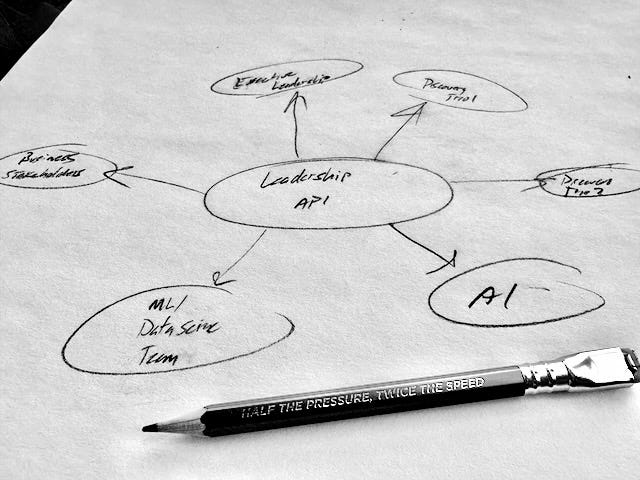
I’ve been thinking about what leadership could look like in organizations where AI supports the execution work. What if your impact wasn’t measured by how many people report to you, but by how your decisions shape the entire system?
I’m starting to sketch out something I’m calling the “Leadership API” (not because leadership is a literal interface, but because it’s becoming more important to design scalable influence than managing more headcount). This framework outlines how influence might scale in an AI-augmented world:
Layer 1: AI-Augmented Execution
Most of my days as a product leader were consumed by meetings, not because I wanted them, but because connecting people with information was critical to execution.
The challenge isn’t creating the strategy, it’s making sure everyone understands how to apply it to their work. That human connection remains essential. No AI will replace the nuance, emotion, and context a good leader brings when communicating vision and strategy.
What AI can do is take on the follow-up work. Once I’ve communicated the vision, AI can help teams understand how that strategy applies to specific situations, flag potential misalignments, and even suggest approaches that align with our strategic direction.
This isn’t about AI making strategic decisions. It’s about AI ensuring consistent application of human-made decisions across hundreds of execution paths.
Layer 2: Strategic Alignment & Business Impact
I’ve always struggled with how limited our visibility was into customer needs and market trends. We’d see fragments of data like important support issues, sales feedback, usage metrics, but never the complete picture.
AI dramatically expands that visibility. Instead of seeing only the loudest signals, we’ll have tools that surface hundreds of patterns from across the business. The challenge for leaders shifts from “finding the needles in the haystack” to “determining which needles actually matter.”
Take customer feedback analysis. Today, we might look at Net Promoter Scores and a sample of comments to identify themes. With AI, we could analyze every customer interaction across every channel, support, sales, usage patterns, social media, to identify emerging issues before they become widespread.
The human judgment of what matters and why remains essential. AI can tell us that users are struggling with a particular feature, but it can’t determine if fixing it aligns with our strategic direction. That’s where leadership adds irreplaceable value, connecting data to strategy and determining where to focus limited resources.
Layer 3: Decision Orchestration
This is where leadership evolves most significantly. In organizations with effective frameworks, decisions become more distributed while staying aligned with strategy.
I’ve seen this work on a small scale. When product teams understand the strategic intent and have clear decision criteria, they make better choices without constant oversight. With AI, we can scale this approach across much larger, more complex organizations.
Instead of leadership being about making individual decisions, it becomes about designing the systems within which thousands of aligned decisions can happen automatically. This isn’t about replacing human judgment with AI, it’s about creating frameworks where both humans and AI can make consistent, aligned decisions.
For example, a well-designed prioritization framework might balance customer impact, strategic alignment, and technical feasibility. AI can apply this framework consistently across hundreds of potential initiatives, while humans focus on edge cases and evolving the framework itself as business needs change.
The most valuable leaders won’t be those who manage the most people or make the most individual decisions. They’ll be the ones who design the most effective decision systems, frameworks that help both humans and AI consistently make good choices aligned with strategic goals.
What makes this potentially powerful is when these frameworks are customized to the specific context and culture of the business. No generic AI solution can understand the unique aspects of your company’s customers, values, and market position. The leadership skill becomes translating business context, customer needs, and organizational culture into frameworks that guide consistent decision-making.
I’m still exploring this concept, but I think it points toward how leadership could evolve, less about direct oversight and more about shaping the environment where thousands of decisions happen.
But what happens when leadership moves from individual influence to system design? The way we structure our teams has to change alongside it.
The Missing Leadership Skill: Human-Centered Organization Design
Organizations today weren’t built with AI in mind. They were designed around how people communicate, make decisions, and coordinate work, all things that AI is now starting to transform.
When I think about the most challenging leadership moments in my career, they weren’t about technology decisions or feature prioritization. They came when I needed to restructure teams to solve new problems or address changing market needs. These decisions were always complex, with limited data and significant human impact.
The real challenge now isn’t just incorporating AI into existing structures, it’s reimagining those structures entirely. What does a product organization look like when AI handles coordination, documentation, and routine decision-making? How do reporting relationships change when information flows directly rather than up and down a hierarchy?
This is where I see the biggest gap in our current thinking about AI and leadership. We talk about AI automating tasks, but we don’t talk enough about how it might transform the organizational structures we’ve taken for granted.
The risk is that we’ll optimize only for efficiency, creating organizations that look great on paper but fail in practice. Team structures that minimize handoffs might also minimize the cross-functional insights that drive innovation. Decision processes that maximize speed might sacrifice the deliberation that catches critical mistakes.
The leadership skill that I think matters most in this transition is finding the right balance, knowing which human connections and inefficiencies actually serve important purposes. Some meetings that seem unproductive on the surface might be creating alignment that prevents much larger problems. Some team dependencies are necessary, plus they can be connections that drive innovation when properly managed.
As someone who values human connection, I find myself increasingly focused on this balancing act. Rather than just asking “How can AI make us more efficient?” I’m asking “How can we design organizations where both AI and humans contribute what they do best?” Technology alone won’t solve these organizational challenges. We need a deep understanding of human motivation, creativity, and collaboration to build structures that work for both people and AI.
The next generation of product leaders will go beyond implementing AI tools within existing structures. They’ll reimagine those structures entirely, creating organizations where technology handles routine coordination while humans focus on the creative, empathetic, and strategic work that machines can’t touch.
What This Means For Your Leadership Evolution
With all this change happening, I keep coming back to a fundamental question: What’s uniquely human about product leadership? What value can we provide that AI simply can’t replicate?
I think there are five areas where human leaders create value in ways that AI likely never will:
- Get your hands dirty with AI — I’m not talking about delegating AI work to some specialized team. I mean actually using it yourself. When I first started with Claude and other tools, I began with basic stuff like summarizing meetings. Those small experiments taught me things about AI’s strengths and blind spots that I never would have understood from reading articles or getting reports.
- Focus on decision quality, not volume — The real question isn’t how many decisions happen in a day, but whether they’re the right ones. Are you building frameworks that guide teams toward better outcomes, or are you stuck in approval loops that create bottlenecks?
- Connect across boundaries — As traditional silos break down, your ability to build bridges between different teams becomes incredibly valuable. Creating alignment between people with competing priorities and different perspectives is a uniquely human skill that multiplies your impact beyond direct reports.
- Find the human element in every problem — The most valuable leadership work happens where optimization algorithms fall short. Understanding the emotional journey of customers, navigating complex stakeholder relationships, and balancing competing values — these challenges need human insight that AI simply can’t provide.
- Shape the environment where decisions happen — Your influence multiplies when you focus on creating the conditions for good decisions rather than making every decision yourself. Creating frameworks that everyone can apply consistently influences far more outcomes than any individual leader could handle directly.
The traditional career ladder in product management, IC to manager to director to VP, was built for a world where coordination was a primary function. But in a future where AI supports more coordination tasks and reshapes the product team, that ladder also needs to be redesigned. Your influence won’t come from the number of people reporting, but instead from how you influence decisions across the organization.
The Closing Window
The reality is hitting hard for many of us in product leadership. Our value doesn’t come from org charts or headcount. It comes from how we influence decisions that ripple throughout the entire organization.
AI will force all of us to make this shift in how we think about leadership. The window for making this transition on your own terms is closing fast. You can either lead this change or get swept up in it.
The leadership roles we’ve been chasing might not exist in five years. But the leadership skills that really matter, creating alignment, designing decision frameworks, balancing AI efficiency with human needs, will be more valuable than ever.
In my next article, I’ll dig into what product leaders should start doing differently right now to stay ahead of AI. I’ll share practical ways to assess where you stand in this transition and specific steps to ensure you’re leading this change, not just reacting to it.
More from AI in Product Leadership
The Interface Roadmap: Beyond the Chat Box
AI interfaces shouldn’t default to chat boxes. Teams that build platform logic and preserve context can embed intelligence where users already work.
Back to the Future: Why AI Needs the Business Logic You Already Have
“Your teams already have the business logic AI needs — it's just implicit. Making tacit decision-making explicit is the real challenge of AI integration.”
Why Every Product Roadmap Needs Meaning
AI-driven velocity without purpose leads teams to ship faster while mattering less. Product leaders need a context roadmap alongside their feature roadmap.