Finding My Writing Style with AI
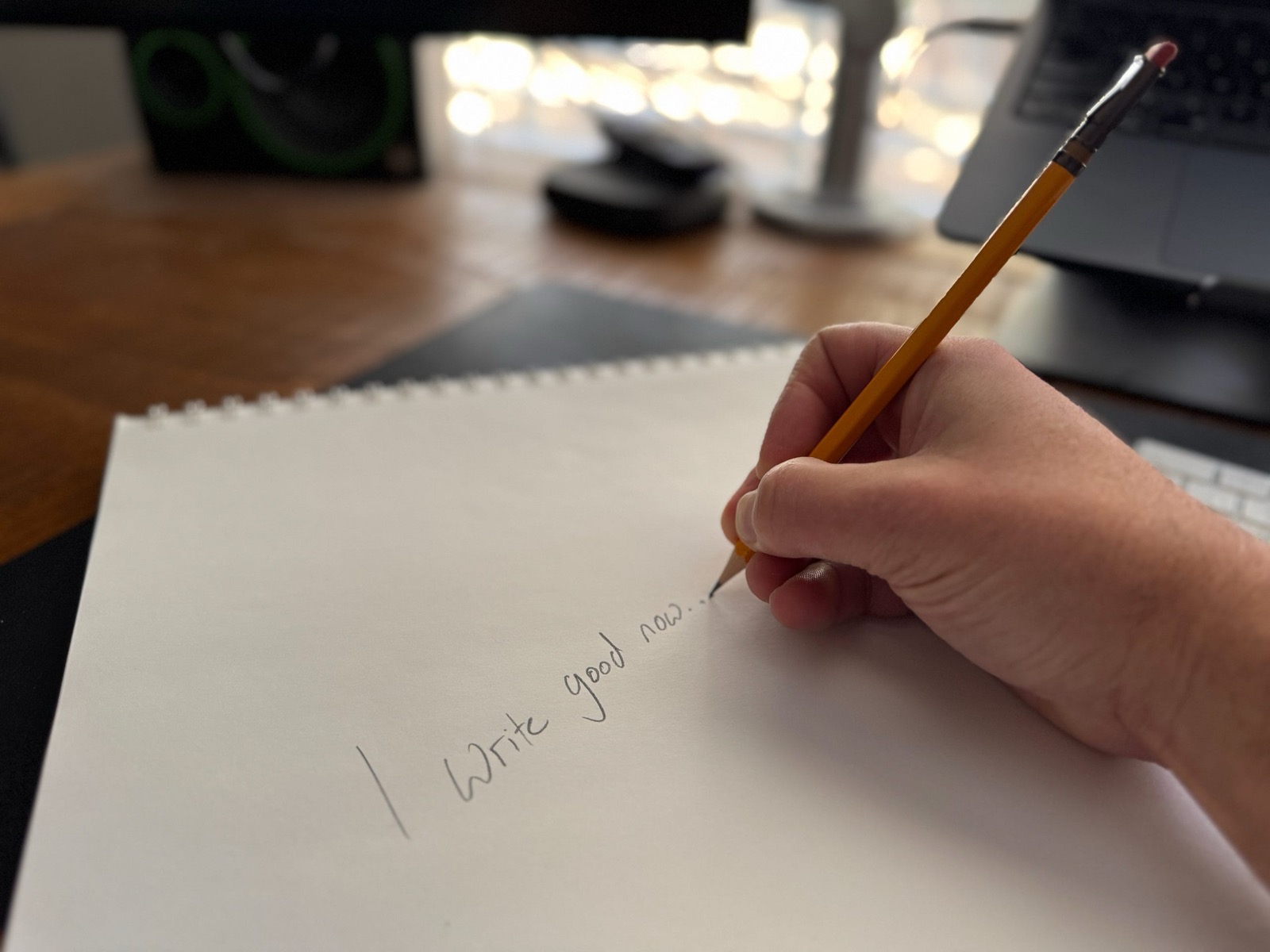
I’ve spent the last twenty-five years honing a very clear, compact, and direct style of writing that works great to communicate succinctly in email and presentations. But I wouldn’t say that style of writing is my “voice” or representative of how I express myself when I’m in conversation. But I also haven’t really explored my own voice in writing and prose since the 10th grade in Mr. Anderson’s English class (he was a fantastic teacher). But now, with the help of AI, I’ve started that exploration again.
Along the way, like many others, I’ve noticed that AI writing has some distinct patterns. And as someone who spent several years coding, I can’t help but notice how these patterns echo programming principles in surprising ways.
The Patterns That Caught My Eye
You know how programmers break big problems into smaller, manageable pieces? I’ve noticed AI does something similar with writing. Not because it’s actually thinking like a programmer (it’s not), but because its statistical patterns create this interesting structural echo.
Let me show you what I mean. When AI writes, it falls into distinct patterns that mirror programming structures:
1. Function-like Blocks: Just as functions in code process input and return output, AI writing often uses rigid setup-payoff structures:
• “Here’s the challenge — followed by the solution”
• “The question isn’t X, it’s Y”
• “While some might think X, the reality is Y”
2. Loop-like Repetition: Like a loop iterating with different variables, AI reuses sentence structures with slight variations:
• “AI can improve efficiency. AI can enhance creativity. AI can boost productivity.”
• “Whether you’re a writer seeking inspiration, a developer looking for solutions, or a marketer crafting content…”
• “This approach works for emails, works for documents, works for presentations.”
3. If-Then Patterns: Programming’s conditional logic shows up in predictable rhetorical structures:
• Problem → Solution: “Traditional methods fall short… AI offers a better way”
• Claim → Evidence: “AI transforms writing… Studies show a 40% improvement”
• Contrast → Resolution: “While the old approach was X, the new approach enables Y”
4. Variable Assignment: Like setting variables in code, AI loves equation-style comparisons:
• “AI is like a co-pilot for your writing”
• “Think of prompts as programming commands”
• “Consider your writing style as the configuration settings”
5. The Em Dash Escape Hatch: Just as programmers use escape characters, AI frequently uses em-dashes as a catch-all transition:
• “Writing is changing — and AI is leading the way”
• “These patterns appear everywhere — in blogs, documentation, and creative writing”
• “The future of writing — a blend of human creativity and AI assistance”
What makes this fascinating is that nobody explicitly programmed these patterns. They emerged from statistical patterns in training data (which makes you start wondering about how we as humans find clarity through deterministic modeling, but that’s a different conversation that should be accompanied by a cocktail). Once you start seeing them, you can’t stop — you’ll spot them everywhere. In fact, this paragraph follows the classic AI pattern: insight, evidence, invitation to engage.
Why These Patterns Matter
These patterns are crucial to understand if you want to work effectively with AI writing tools. When you know what to expect, you can:
• Guide the AI toward more natural variations by breaking up its tendency to fall into repetitive patterns
• Use its structural tendencies to your advantage when you need organized, clear content
• Know when to step in and add the human touch that makes writing feel like you
At first, I fought against the AI’s tendencies, trying to force it into what I think is a more natural writing style. But then I let go and started leaning into it, letting AI writing flow while I helped shape the patterns it used strategically. Now, I let it help with structure and initial drafts, then when I’m ready I move it to a word processing app and add my own voice, examples, and rhythm.
The Writer’s New Power Tools
My writing process now involves a whole suite of AI tools, each bringing something unique to the table. I fire up ChatGPT to explore different angles, use voice chat during my commute to brainstorm, and lean on Claude for initial drafts. My wife, however, swears by ChatGPT (she says it’s more creative), which just goes to show how personal these preferences can be.
For fact-checking and research, Perplexity and Gemini with Deep Research have become indispensable. Perplexity’s real-time web access helps me verify facts and find recent sources, while Gemini can dig deep into topics I want to explore further. Perplexity has saved me from more than a few embarrassing errors, especially when writing about fast-moving topics.
I’ve developed a kind of creative relay between these tools. A typical piece might start as a rough draft in Claude, get refined through conversations with ChatGPT or Gemini, run through Perplexity for fact-checking, and finally land in Microsoft Word where I shape it with my own voice. I’ll often give it one last grammar check in Claude before calling it done. Each tool adds its own perspective, creating layers of refinement throughout the writing process.
My Journey Will Continue
I think we’re all in the middle of a transformation in how people write and express themselves. AI brings powerful capabilities for structure and organization, but the heart of good writing still comes from human creativity, emotion, and lived experience.
Some folks worry that AI’s widespread use on LinkedIn and other platforms makes everyone’s writing sound the same. They’ve got a point, but I see this as a temporary phase. These tools give a voice to people who’ve struggled to articulate their thoughts clearly. When someone has something meaningful to say, the specific writing patterns matter less than the ideas themselves. It’s all about knowing when to embrace AI’s structured approach and when to break free for something more personal and unique.
Nobody should feel afraid or embarrassed about using AI in their writing process. I write every single day now, and each piece helps me find my voice. That voice grows stronger all the time, supported by AI but distinctly my own.
More from AI-Human Partnership

Embrace the Mess
Working with AI is messy on both sides — probabilistic outputs, answers that have to be argued with, judgment calls neither side could make alone. The disproportionate outcomes come from staying in the back-and-forth instead of trying to engineer the mess away.

Beyond the Loop
Human in the loop is a good place to start, but working with AI as a genuine partner — where roles stay fluid and context compounds over time — unlocks work you can't build alone.

Making It Personal
AI doesn't have to be something that happens to you. Personal use is where you build the relationship, the judgment, and the agency to shape how AI shows up in your work and life.